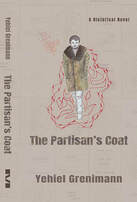
The Partisan's Coat
A mysterious historical novel set in Israel By YEHUDIT COLLINS, JANUARY 27, 2024 Excerpt from The Jerusalem Report: "The Partisan’s Coat is Grenimann’s second novel. In a way, it could be called a coming-of-age novel." "Yehiel Grenimann is the son of Holocaust survivors. His mother escaped not only the Nazis but also a Soviet work camp; and his father fought with the partisans. Grenimann was born in Australia and made aliyah in 1973, when he enlisted in the army. Having retired from his position as field director for Rabbis for Human Rights five years ago, Grenimann is now making a name for himself as a distinguished writer. He lives in Jerusalem with his wife, with whom he has four children, and seven – soon to be eight – grandchildren. The Partisan’s Coat is Grenimann’s second novel. In a way, it could be called a coming-of-age novel, as it follows Joey (Yoseph), a shy boy, trying to fit in as a normal Aussie, through to becoming a middle-aged Israeli husband and father. Coming from an assimilated Jewish family, Joey is pulled between a volatile father, so traumatized by the war that he no longer wants any association with Judaism or Zionism; and his mother, who wants him to retain some connection to his Jewish roots. And this becomes a source of friction in his parents’ marriage. While playing one day in the shed where he hides to escape his parents’ arguments, and an annoying sister, he finds and becomes obsessed with the coat, of the title, and is intrigued to learn that the mysterious previous owner, named Bora, had been a partisan leader. He is even more thrilled to find a genuine bullet hole in the coat. The coat follows him through the book to the very end. It becomes a sort of talisman and an object of veneration linking him to imagined, heroic deeds, which he aspires to emulate." ....... "The book sustains page-turning interest, while giving an authentic view of Israel, warts and all – often good, sometimes bad, and occasionally ugly, but always a beloved country." https://www.jpost.com/israel-news/article-783561 
The Weight of Gold: Attaining Your Potential Through The Lens of the Bible
by Moshe Silver A rabbi offers ancient insights from the Torah to contemporary readers of all faiths. Initially written for an audience of one, this book’s origins began with Silver’s friendship with an African American Christian who asked him for “the Jewish point of view” on biblical passages. This “new reading of the Torah” emerged from the friends’ conversations. As an Orthodox rabbi who lives in Jerusalem, Silver has a keen understanding of Jewish philosophy, tradition, and history. Here, this expertise is combined with pragmatic ways that readers of all faith traditions can make a “better world.” The rabbi begins with a brief introduction to Judaism geared toward gentiles, providing definitions and backgrounds on central terms that range from Torah itself to Maimonides and Hasidism. Silver’s Torah commentary forms the main body of the book and offers Jewish interpretations on stories that span from Adam and Eve through Moses. Complementing the accessible distillation of Jewish traditions is an emphasis on practical applicability. Reminiscent at times of self-help literature, the author provides uplifting messages relevant to contemporary life (one chapter is even centered on the modern parlance of social distancing). The story of Isaac, for instance, teaches a universal message: “It’s not what we inherit, but what we do with it that makes all the difference.” Though a distinctly Jewish text, the book succeeds in its efforts to welcome all. Readers are just as likely to encounter Talmudic literature and the Psalms as they are the philosophies of Malcolm X, Bob Dylan, and Bob Marley. The teachings of other religions, from Christianity to Buddhism, are also referenced. Even while holding fast to his Orthodox training, Silver is ever sensitive to contemporary reevaluations of spirituality, carefully avoiding, for example, using gendered pronouns (He/Him) to refer to God. Though a bit more background on Jewish terminology and practice might be useful to neophytes, this “Torah for everyone” is a captivating primer on Jewish teachings. A smart, inclusive, and approachable introduction to the Torah. …Kirkus Reviews |
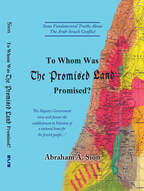
To Whom Was the Promised Land Promised? Some Fundamental Truths About the Arab-Israeli Conflict.
by Abraham A. Sion This book presents a challenge to those institutions and individual scholars who deny or minimize the Jewish people’s ownership rights over Mandatory Palestine in international law. The author, an emeritus professor of law, Ariel University, insists upon the vital importance of decisions made during and after the First World War. The defeated Ottoman Empire renounced its rights to most of the areas of the Middle East which it had ruled in favor of the allies who had defeated them. Thus, the Balfour Declaration, the San Remo Resolution, and the Mandate for Palestine created a new political and legal reality in the Middle East, creating new Arab states in Lebanon, Syria, and Mesopotamia and a Jewish national home in Palestine. Sion explores this history closely (including Britain’s failure to live up to the requirements of the mandate it held over Palestine) and reads the documents closely. This is an important contribution to the research and debate concerning international law, the State of Israel, and the Land of Israel. …Association of Jewish Librarians |
Copyright © 2024